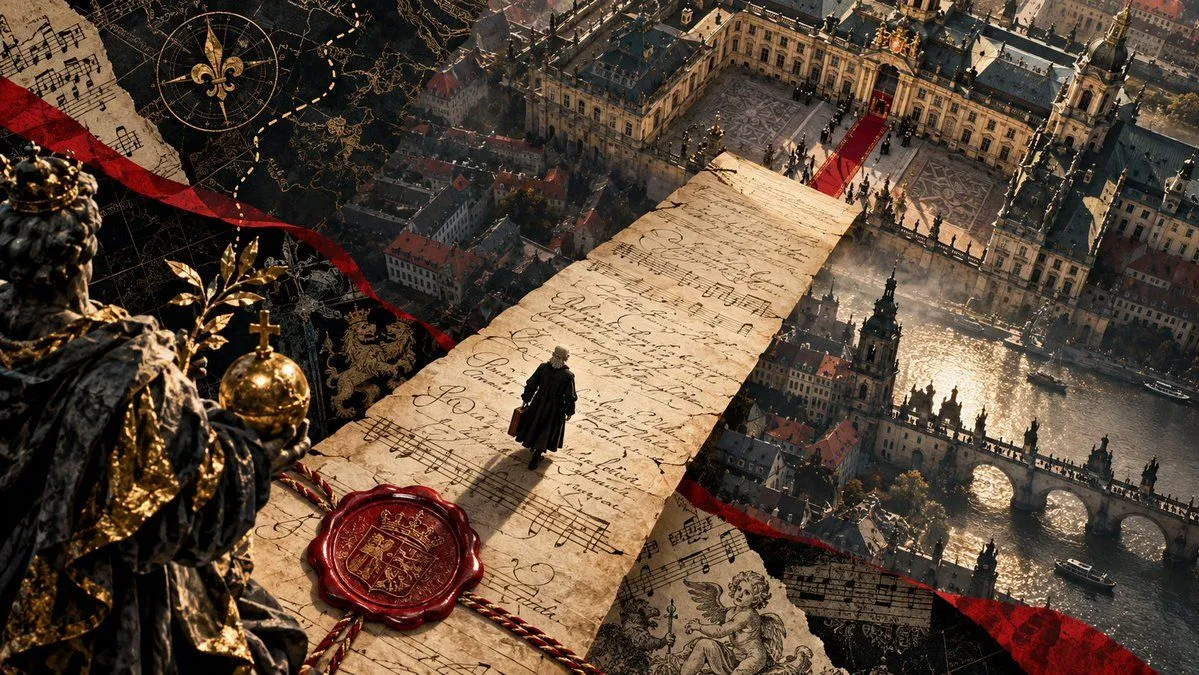
Bach's Musical Petition to Dresden
Goal: Create a cinematic, high-resolution digital illustration depicting the historical moment of composer submitting his musical petition to the court in Dresden. Canvas: Wide aspect ratio (16:9), photorealistic 3D render style with dramatic lighting and rich textures. Layout & Composition: - **Foreground Left:** A close-up, slightly out-of-focus statue or bust of a crowned monarch (King Augustus III) wearing heavy velvet robes with gold embroidery and holding a golden orb. This frames the scene on the left. - **Center Axis:** A massive, long scroll of aged parchment stretches diagonally from the bottom center toward the top right, acting as a bridge or path over the city below. The parchment is covered in handwritten cursive script and musical notation (staves and notes). - **Midground Center:** A tiny figure of composer, dressed in black 18th-century attire with a white wig, stands on the parchment scroll, looking down at the document he has written. He holds a small leather satchel. - **Background Right:** An aerial view of the historic city of Dresden. Key landmarks include the Zwinger Palace with its ornate baroque architecture and red carpet entrance, the Hofkirche (Court Church) spires, and the Augustus Bridge spanning the Elbe River. The river reflects the sunlight. - **Overlay Elements:** Scattered around the edges are torn fragments of sheet music, a golden compass rose symbol, a red wax seal with a coat of arms attached to the main scroll, and flowing red ribbons that weave through the composition. Visual Style: - **Lighting:** Golden hour sunlight hitting the city and the parchment, creating strong contrasts and shadows. Warm tones dominate. - **Texture:** Highly detailed paper grain on the scroll, stone texture on the buildings, fabric texture on the king's robe. - **Atmosphere:** Majestic, historical, and artistic. It visualizes the concept of "music as a plea for status." Text Content: - The handwriting on the scroll should be illegible but stylistically accurate to 18th-century German Kurrent script. - Musical staves should look authentic. Constraints: - Do not make the text readable English; it must look like a historical manuscript. - Ensure the scale difference between the giant scroll/king and the tiny composer is exaggerated for dramatic effect.